
Healthcare organizations generate enormous volumes of data, but most struggle to convert that data into actionable intelligence. The Ursa Core Data Model organizes, enriches, and connects healthcare data into a reusable foundation that supports everything from executive reporting to advanced AI applications.
Organizations are racing to deploy analytics, predictive models, and generative AI. Yet most initiatives stall because the underlying data remains fragmented across claims systems, EHRs, billing platforms, quality programs, and operational applications.
Without a common data foundation:
The Ursa Core Data Model solves this challenge by creating a healthcare-specific foundation that standardizes data, preserves business logic, and makes information reusable across every downstream application.
Most enterprise data platforms were built for transactional industries like retail, finance, or technology. Healthcare is fundamentally different.
Patients move through complex journeys spanning years. Clinical, financial, operational, and social factors interact continuously. Valuable insights depend on understanding relationships across many systems and many points in time.

The Ursa Core Data Model is purpose-built to represent these relationships, creating a longitudinal view of patients, providers, encounters, conditions, interventions, costs, and outcomes. This healthcare-native architecture makes complex questions easier to answer and accelerates every analytic workflow.
Our connectors ingest and standardize data from across your ecosystem:
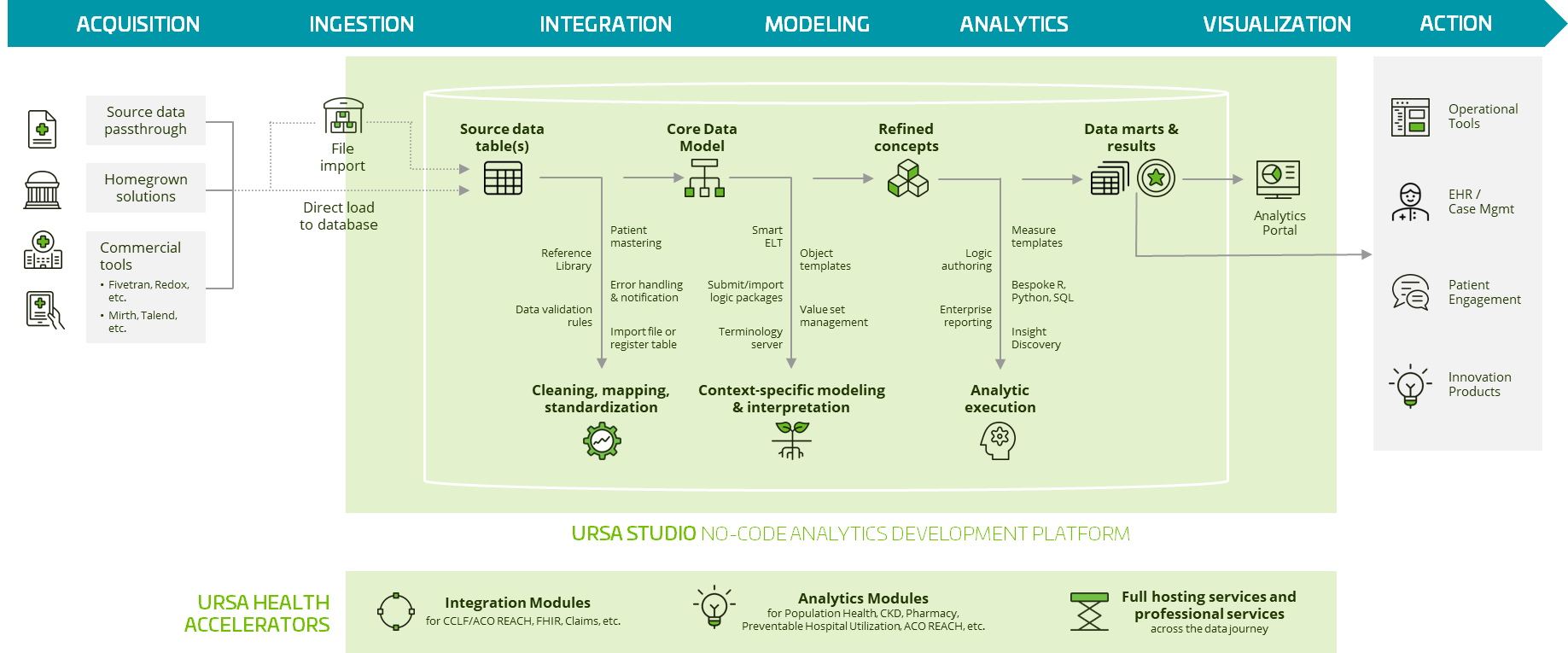
Instead of starting every project with data cleanup and reconciliation, teams begin with a trusted, reporting-ready foundation enriched with healthcare reference data and standardized business logic.
Traditional data warehouses create silos of duplicated logic spread across reports, dashboards, extracts, and analytic projects.
The Ursa Core Data Model uses a hierarchical architecture that allows data assets to build upon one another. Definitions, calculations, and business rules become reusable components rather than one-off development efforts.
The result:
Greater Reusability
Build once and leverage everywhere.
Consistent Definitions
Shared logic creates trusted metrics across teams.
Faster Development
New analytics projects start from existing building blocks.
Easier Maintenance
Refresh and update entire dependency chains automatically.
Generative AI and healthcare copilots require more than access to data. They require access to trusted, structured, well-governed data.
This allows AI applications like Ursa Compass to answer questions using trusted healthcare intelligence rather than disconnected data sources.
The Ursa Core Data Model provides:
Access trusted metrics and definitions without relying on technical teams to interpret every result.
Spend less time preparing data and more time answering important business questions.
Focus on innovation and advanced analytics rather than repetitive ETL and maintenance work.
Faster Time to Insight
Accelerate analytics development with pre-built healthcare concepts.
Trusted Reporting
Establish consistent definitions across the enterprise.
Reduced Technical Debt
Eliminate duplicated logic and fragile reporting processes.
AI Readiness
Create the foundation necessary for successful healthcare AI initiatives.
Scalable Innovation
Support new use cases without rebuilding your data architecture.
Analytics, reporting, predictive models, and AI all depend on the same thing: trusted healthcare data.
The Ursa Core Data Model provides the foundation healthcare organizations need to move faster, make better decisions, and unlock the full value of their data.